
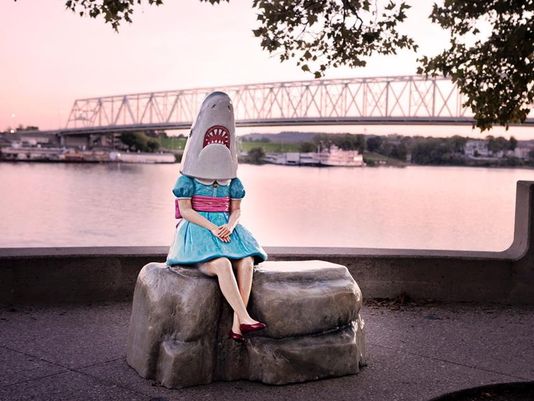
Did you know that Buffalo is often listed on top 10 lists of cities to take selfies? Bhakti Sharma, Associate Professor and Chairperson of Interior Design at SUNY Buffalo State, will explore the connections between public art and revivals of cities. You’ve probably heard of “public art for public good,” but what does it mean to link artistic production to the economic vitality of cities? How does art galvanize a sense of community and local culture? How does the localization of public art in neighborhoods reflect the changing neighborhood?
What do you think about the connection between an explosion of public art and Buffalo revitalization? Certainly, there have been an exciting number of new art installations, murals, and sculptures placed in or scheduled for public spaces in Buffalo. You’ve probably heard or seen Casey Riordan Millard’s Shark Girl, (who even has a Twitter account with 1800+ followers!!!) but the most recent include Brooklyn-based artist Amanda Browder‘s forthcoming August large-scale fabric installation dressing three downtown Buffalo buildings: Richmond Methodist Episcopal Church at Richmond Avenue and West Ferry Street, the historic Eckhardt Building at 950 Broadway, and the Albright-Knox’s Clifton Hall.
Public art can also offer an opportunity to involve the community directly in the creation and material of the artwork. Browder and the Albright Knox are asking Buffalonians to drop off fabric and participate in sewing the large patchwork fabric. You can find the drop-off locations and public sewing dates here.
For long-time Buffalo residents and new visitors alike, taking selfies at Buffalo’s many public art pieces can be a fun scavenger hunt. The Albright Knox Gallery, a Buffalo Humanities Festival partner, established a Public Art Initiative in 2013 that was joined by the city of Buffalo in 2014. The Initiative commissions art specifically for public sites in Buffalo and range widely in media, location, and content. For photo documentation, visit the Albright Knox Public Art Initiative Site. Or make your own photo documentation! Take selfies at one or more of these public art sites and share them with us (@ubhuminst) on social media with #BHF16 or #bfopublicart … In fact, we’re throwing down a challenge: you’ve got almost two months to catch them all* before our Humanities Festival begins!
Do you have a favorite public art piece? Let us know on Facebook or Twitter! And don’t miss Bhakti Sharma’s talk, “Public Art: Top Ten Lists and Other Gains,” on Saturday, 9/24 from 1:00pm-2:00pm in Rockwell 304.
*Dear @sharkgirlbflo: we know you are not a Pokemon!
 Buffalo Humanities Festival
You must be logged in to post a comment.